

Review: New Space Capitalism
Private Property on the Final Frontier

These days, I see many negative takes about space and space colonisation - from social media posts, to articles, and even whole books denouncing the enterprise. There is a whole cottage industry dedicated to trying to convince people it igovernment leds entirely stupid and evil. I have reviewed some of this material, but often I just have to skip over it as there is only so much repetitive, and wrong, negativity I want to listen to.
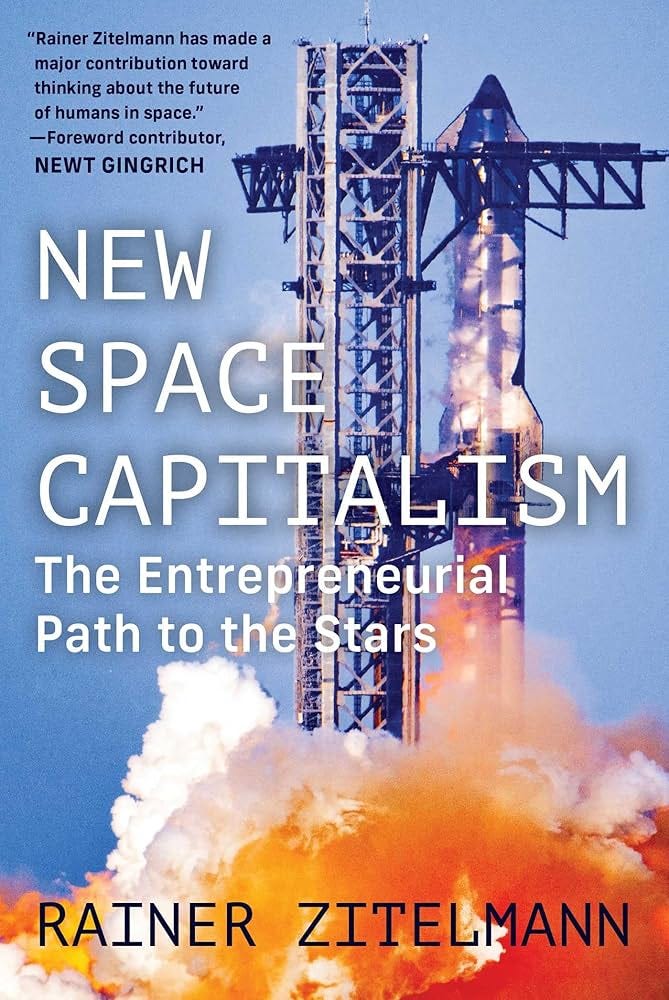
A new book New Space Capitalism offers a more positive outlook, takes on the arguments of the doomers, and offers practical suggestions for how to shape the new frontier.
Dr. Rainer Zitelmann is a noted author in the social sciences, which gives him a different perspective than most people in this debate (such as myself) who come from STEM backgrounds and only dabble in sociology, economics and the like where they intersect with our concerns.
His core idea is a simple one - “Only when it is possible to own, buy and sell land on other celestial bodies can humans truly become a multiplanetary species”. I agree with this idea, in fact I find it so obvious on the face of it that it ought not to be necessary to write a book arguing this case - but it is necessary, because there is an entire cottage industry arguing against both private property and space colonisation, often at the same time. This is done under the banner of “ethics” or “planetary protection”, and the book details some of these arguments - such as the notion of the colonisation of uninhabited planets being “western antimineralism” i.e. prejudice against rocks, or that indigenous shamans have some prior claim to the Moon, contrary to both reason and the Outer Space Treaty. In this context, a reaffirmation of property rights, one of the basic foundations of western civilisation, is very useful.
On technical matters, Zitelmann often defers to domain experts like Robert Zubrin, John Logsdon, and Rand Simberg. I spotted a few minor mistakes in this part of the book, but nothing hugely consequential and nothing that undermines the central thesis. A novice coming to discussions of space for the first time with this book would not end up with any significant misconceptions, which is more than can be said for a lot of works in this field.
The main body of the book though regards public policy, and specifically how space exploration became trapped in a quasi-socialist, government-led paradigm after the Apollo programme, and how this is a mistake in the opinion of the author.
The Apollo Anomaly
The success of the Apollo programme is one of the most remarkable events of the 20th century. Not only did a huge government programme come in on time, and only slightly over budget, but it was a project to do something which had never been done before. When President Kennedy set the goal of the Moon, the US had around 15 minutes of spaceflight in total from Alan Shepard’s brief suborbital hop. But they did it, and astonished the world.
This has led to a “Moonshot” mentality from politicians, which Zitelmann illustrates with examples such as Richard Nixon becoming fascinated with desalination technology, and believing he could retask NASA to developing it after Apollo, as if engineers and scientists were interchangeable problem-solving units that can be arbitrarily rearranged and made to produce specific breakthroughs on demand for their political masters.
A more reasonable framing of this idea is provided by Mariana Mazzucato in her book Mission Economy, which attempts to take general lessons from Apollo to argue that big state projects can and should be organised along similar lines to solve big problems, and that indeed the state is the best vehicle for doing so. This notion is one of the largest intellectual targets of the book, and is frequently revisited. Zitelmann’s more liberal view, illustrated with numerous examples, is that in various times and places human ingenuity has flourished in spite of the state rather than because of it.
While it is correct that “Moonshots” are almost universally a failure, and Apollo clearly can’t be generalised to anything the current government wishes would happen, as a glaring example of a successful programme it does deserve some explanation. I have taken a shot at it myself:
Setting Apollonian Goals

In January many of us set new year resolutions - lose weight, give up a vice, exercise more etc. - and usually struggle to stick to them. It is the same way with societies too - governments announce lofty goals only to swiftly disappoint everybody. Quite often, this will take the form of something being touted as a “moonshot”, and as far as I can tell, …
There is some acknowledgement of the positive role of the state later in the book, but citing public choice theory Zitelmann ultimately rejects government-led programmes as a way to economically develop space, and prefers the state at best as a mere customer. This part I don’t (yet) agree with - I think, certainly in Europe and probably in the US and China, the private market just isn’t mature enough to stand up on its own. A well-designed government-led space initiative in the right circumstances can work - Apollo proved it - and may be the best way to get to the point where private space interests can take over fully.
Space Property
Where I am in stronger agreement is on what the final goal should be - a solar system of property rights, where the huge investments required to develop space can provide returns to those who take the risks.
This book takes a strong stand on the often-discussed issue of what the Outer Space Treaty (and its misbegotten offspring the Moon Treaty) actually says about private property claims. The final chapter challenges the many people trying to squeeze “space socialism” out of the OST after the failure of the Moon Treaty to enshrine it in international law explicitly.
The case is made well, with examples of how a real, capitalist space economy may work. But I suspect that this might be the start of the debate, not the last word. It is not so easy to separate intellectuals from what Friedrich Hayek called the “fatal conceit” that they are wise enough to centrally plan everything. Why should the vast bounty of space be left in the selfish, anarchic hands of capitalists like Elon Musk and Jeff Bezos, when there are people with Very Good Degrees out there who can perfectly direct resources towards the greatest collective benefit?
Too much media these days consists of people talking to people they already agree with for an hour or more, and having a lovely chat about how everyone who disagrees with them is stupid, crazy and evil. I would recommend that the anti-space crowd read this book as much as the pro-space crowd; and perhaps some of the space socialists mentioned in the book may be willing to challenge Dr. Zitelmann to a public debate.
New Space Capitalism is available to pre-order now
Come on Peter! Let´s write a comedy novel about Space Communism! We´re gonna have to ration the asteroids, because surely there aren´t enough to go around. "All spacesuits are equal when they´re leaking, but some are more equal pressure with the vacuum than others." I could go on and on.
I don't like the space socialists one bit, but I suppose I prefer the space socialists to the outright anti-space leftists we see kicking around today. Believing the government can do it all is misguided, but considering the amount of articles casting doubt on the whole premise in any form whatsoever, even space socialism seems like a point from which progress can be made. The success of Elon Musk has sort of required that space socialism collapse, because it's so overwhelmingly clear that he's outstripped all previous state space programs that you essentially have to move to "Bah! Space sucks anyway and is taking stuff from poor brown people!" in order to have anything left.
In a similar vein, the small number of leftists hoping to nationalize AI are at least reckoning with it as a form of power that will exist now versus the copers who want to ban it all, or simply wish it out of existence by seething enough.