

Who Watches the Space Watchers?
Not everybody is happy about the revolution in spaceflight, even in a nation not that involved...

For as long as humanity has been sending rockets into space, there have been people complaining about it. Recently I’ve found a group in the UK that have taken that position.
Space Watch UK appears to be a spin-off of CND, and the general interconnected left wing protest scene. We can see an Extinction Rebellion logo on one of their banners here.

I get the feeling that these protesters have not given serious thought to space matters, and are not especially interested in the topic. To them, its just another facet of militaristic, colonial Western society they object to.
But lets take what they say seriously, and address the points they make.
Nuclear Moon
Space Watch have complained bitterly about some reporting on space nuclear reactors being developed in the UK.
They highlight the example of Kosmos 954, a Soviet satellite with a small reactor on board that suffered an uncontrolled reentry and burned up over Canada. They cite the fact that less than 1% of the nuclear fuel was recovered, which is true. But what they don’t mention is that the clean up ended because it was found that the remaining material was finely dispersed, its radioactivity was rapidly dropping, and it did not pose a danger to humans or the environment.
This was a concerning incident though - the Soviet government paid compensation to Canada, and was rightly criticised for losing control of a space nuclear reactor. Some of the fragments recovered were dangerously radioactive, and had they fallen on a populated area instead of a remote part of Canada, there may have been casualties.
Which brings us to their objections about this particular space reactor project - its for reactors for use on the Moon, and in it there is a statement that the reactor would only be turned on when it reached the surface of the Moon, precluding a Kosmos 954 style accident. Space Watch UK responds to this with this snark:
The scientist who has discovered how to switch radioactivity on and off should be nominated immediately for the Nobel Prize in Physics: such a discovery is an amazing breakthrough which totally rewrites all our previous understanding of the laws of nature.
We discovered how to “switch radioactivity on” back in the 1940s. It is kind of critical for all fission technologies. The point that seems to have been missed here is that a “cold” reactor, i.e. one that has not yet undergone large scale fission, has little radioactivity to it. Once the nuclear chain reaction is started and fission products appear - those are highly radioactive, and the “hot” reactor is now a radiation hazard if that material gets out. This is the elementary physics of nuclear reactors, which someone criticising them should know. And none of it “ rewrites all our previous understanding of the laws of nature”
The group is ignorant of nuclear physics here, and based on that misconception a correct reporting of the matter sounds ridiculous to them, and they mock it performatively for their (presumably equally ignorant) readers. This is an entirely unserious argument, so lets move on and see if they have done better elsewhere.
The Money Argument
In 2023, the group in its first action protested the Virgin Launch attempt from Newquay spaceport, which ultimately failed during the second stage burn. Space Watch UK opposed this flight on the grounds that some of the payloads the rocket carried were military.
Their core objection was that space should not be militarised at all, and that the UK “should be upholding and extoling the virtue of the Outer Space Treaty, signed in 1967, which recognises that space is a ‘global commons’ to be used for peaceful purposes and for the benefit of all countries and humankind” (sic)
First, the militarisation of space is a done deal and can no more be rolled back than the militarisation of the air can be. It is a domain of war, as has been shown decisively in Ukraine, and that genie will not go back in the bottle. Secondly, the group seems not to understand the Outer Space Treaty. It is not, despite the hopes of groups such as this one, some kind of transnational constitution for total peace in space. It does not ban non-nuclear weapons from space, and certainly does not ban unarmed military assets such as reconnaissance satellites or military communications satellites from space.
A second plank of their objection is that they do no want commercial exploitation of space. Again, its a bit late to protest that - 18% of the UK economy relies on space services. Being charitable perhaps they mean as yet unrealised commercial activity like asteroid mining - but a small bunch of cubesats wasn’t ever going to do that.
It is hard to pin down the specifics of why they didn’t like the launch. One protester, though, held up this sign which raised the issue of opportunity costs:
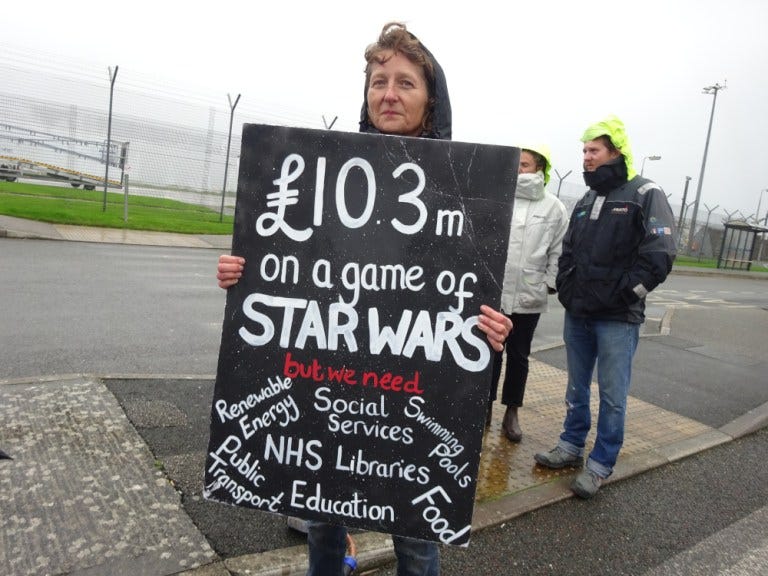
I’m not sure what a “game of Star Wars” is, but the figures involved are ridiculous.
£10.3 million is essentially pocket change for a government like ours. One of the supposed better uses of this money listed is the NHS. That amount of money would run the health service for about 30 minutes. The benefits uprating in the UK this year - as in the automatic increase in existing entitlements to match inflation, not any new social spending - is £18 billion - 1800 times the value listed here, and roughly equivalent to the annual NASA budget. No social service has ever gone unfunded due to a nation spending money on space.
I believe there are several layered misconceptions here - beyond how little space missions cost next to the cost of expansive social spending. There is the idea that UK government services are starved of funding - when the reality is that most of them (notably the NHS) have their real terms budgets increased every year. There is the ‘lump of labour’ fallacy that people who work on rockets can be simply reassigned to do whatever task the protester thinks is more important. There is the notion that nothing beyond basic subsistence can be attempted while ever there is any indication of poverty in society, which if taken seriously would amount to a dismantling of society and the economy - to such an extent that it would make poverty much worse.
It comes across as a cheap shot - because only government spending a particular speaker doesn’t like is portrayed as some kind of theft from the needy in this manner. It is an argument that presumes the thing its trying to persuade you of - that space isn’t worth doing. Unfortunately, despite its logical flaws, this kind of populist argument lands well with those concerned with poverty.
How to Respond
By writing this article, I’ve essentially given exposure to this group while refuting their arguments. Is that a good idea? Maybe, maybe not. As a society we should keep lines of communication open with those with disagree with - recent events in the UK have, I think, shown the dangers of political conversation breaking down. To that end, please consider sharing this article:
I cannot ever see myself finding common ground with a group like Space Watch UK. Perhaps some people who might otherwise be drawn to them could be persuaded to change their minds though.
This is the end of the article. This one is free for all readers, but some of my work is for paid subscribers only. Upgrading gets you full access to articles like these:
The history and current state of the art of partial gravity research, important for building human colonies on Mars or the Moon.
How the threat of ASAT weapons and satellite constellation technology could lead to a militarisation of space.
…and many more, including my regular monthly Mass Value Report where I apply a unique analytical lens I developed in this paper to the launch and space industries.
To subscribe costs about the same as a cup of coffee every month. Would you buy me a coffee to hear a complete set of my insights each month?