

The New Berlin Wall
One of the key debates of the 21st century strangely echoes the 20th century.

It has been 65 years since the German Democratic Republic erected the Berlin Wall, which became a damning symbol of the amorality of communism that no amount of propaganda could dismiss. You simply do not need armed guards and razor wire to keep people in utopia. You don’t even need them to keep people in mildly functional countries.
The Wall has, thankfully, now been demolished for longer than it was erected. The Soviet Bloc is receding into history, and it might seem that this symbol of its tyranny is no longer relevant.
But all of us still face one specific restriction on our movement, and it will define the twenty first century - we cannot move out into space. Aside from the obvious physical and technical barriers, the legal situation is unclear and not very permissive. Technologically, we are rapidly moving into an age where it is feasible to colonise the solar system, but there are those who would try to wall us into this planet using legal and political means.
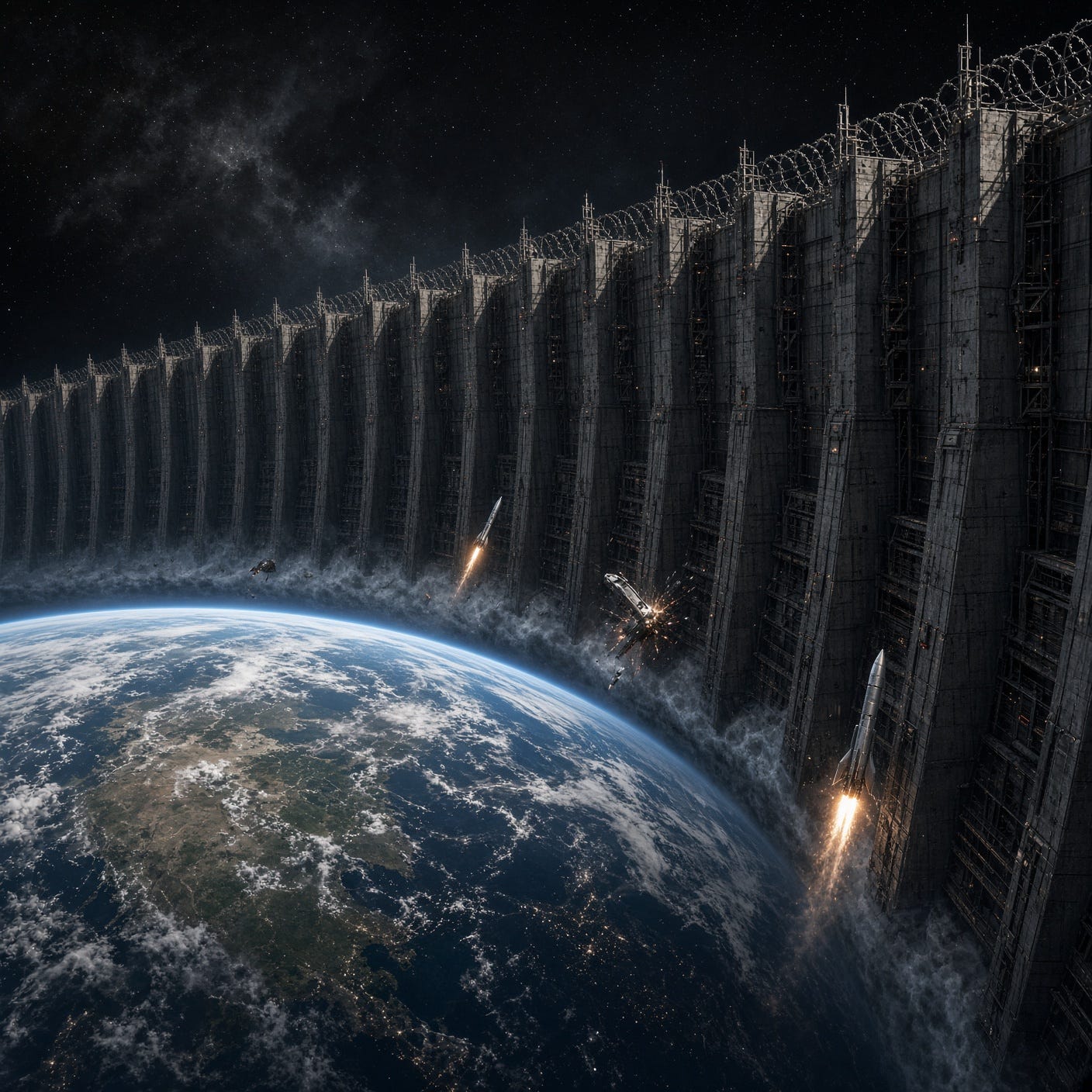
The new wall is not built of concrete. Physically, it is simply the great difficulty of lifting anything out of our planet’s gravity well. Socially, it is the gatekeeping of the technological means to do this. The fact that colonising space requires very large numbers of people, significant material resources, and cooperative places to launch from means that whether or not it happens is subject to public debate, and a wall can be built from arguments in this debate.
Some in the debate make this explicit. In his book Dark Skies, Daniel Deudney argued that the entire enterprise of space colonisation should be proactively shut down, because it would produce some dangerous offshoot of humanity that would represent an existential risk to us. He claimed rogue colonies would be able to rain down asteroids on Earth, but this was not considered a credible weapon by space experts. However, many people still found the book to be convincing.
The Berlin Wall itself evolved from administrative border restrictions into physical force. In a way we are already at this stage - under Article VI of the Outer Space Treaty, anybody wishing to take a colony ship to Mars must do so under a launch licence. A celestial border check, if you will. Many people such as Deudney, and the more extreme advocates of planetary protection, want to harden this into a true barrier.
The United Nations
In a recent article for Space News, planetary scientist Adriana C. Ocampo Uría argues for the exploration of Mars to be conducted “not as a nation, but as a planet”. The article is worth reading in full, but the core of it is a proposal for a “UN-affiliated Planetary Stewardship Council” under the United Nations that would essentially be the authority under which all nations, companies and individuals would have to operate on Mars and in other parts of space.
This is not a total restriction on people leaving, as the stronger advocates above suggest, but it would constrain exploration and likely rule out colonisation if implemented. While in principle, it still permits humans to leave Earth and go elsewhere in the solar system, it does not let them leave the polity of Earth. It, accidentally or intentionally, removes one of the key motivations for going.
Jared Isaacman, the current Administrator of NASA, himself rejected this approach:
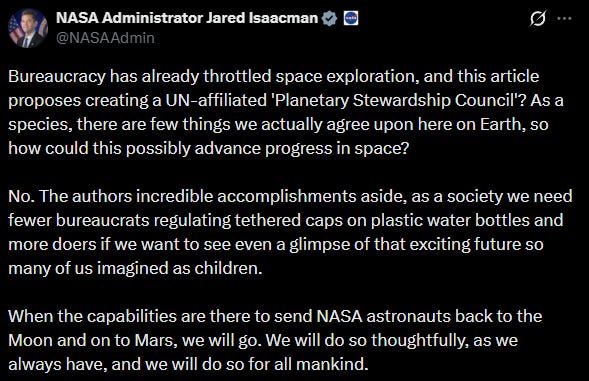
However, political winds often change, and it might be in the not too distant future that the leadership of NASA and other space agencies come to approve of the restrictive, bureaucratic approach.
This is not to say that coordination between nations is a bad idea - indeed, while rejecting the UN-led approach, Isaacman like the rest of the Administration supports the expansion of the Artemis Accords and speaks of the mission for all mankind. The assignment of the electromagnetic spectrum and orbit slots happens right now with little fuss, and with nobody being excluded from space altogether. A body with true veto power though crosses from sensible multilateral agreements into a transnational authority which could constrain basic rights.
The Fundamental Freedoms
The Berlin Wall represented a gross and highly visible violation of the basic freedom of people to leave a place. This is a critical freedom when it comes to space colonisation, both in terms of the freedom of humans to leave Earth and the freedom to leave colonies that are not functioning well. It is sufficiently core to my own thinking that it inspired the name of this newsletter.
But there is also another freedom at play. You are free to leave, but you are not free to go anywhere you please if it is already occupied. This asymmetry is widely recognised - for instance, while Article 13 of the Universal Declaration of Human Rights provides the right to leave, Article 14 only provides the right to seek refuge - not for it to be granted unconditionally. The reason is that places are defined as much by their people as by anything else, and if everyone can move anywhere in a totally free mixing scenario, the distinction of place is erased and freedom of movement is effectively curtailed.
This is why I am not surprised when I see that those who tend to be restrictionist on space colonisation are liberal on terrestrial immigration, and vice versa. For instance, Zach and Kelly Weinersmith authored the book A City on Mars which argued for very strict controls on what can be done in space. And explicitly for a pause to settlement plans until those controls are in place:
We believe humanity in general, and possibly the long-term project of space settlement in particular, would be better off with an internationally managed system that regulated both where people are allowed to set up shop and what they’re allowed to do with the local resources once they get there. It wouldn’t be dynamic, it wouldn’t be like a science fiction novel, and frankly it would be very slow and bureaucratic and boring. But it would keep the peace while humanity gets its political and technological act together enough to make space settlement possible.
But Zach also illustrated Open Borders by Bryan Caplan, arguing for literally what its title said. The seemingly contradictory views that people should be able to move around Earth without any restrictions whatsoever whilst arguing that they should be restricted from leaving Earth both serve the same objective, of combining the entire human race into a single continuous polity. One from which, by definition, there is no escape.
Doing so would remove a critical error correcting mechanism from human affairs, a problem identified as far back as Immanuel Kant - who believing the idea of a world republic was theoretically correct, still argued that it should be a voluntary federation, with members free to leave, rather than a centralising state. Such a state would be even worse for human affairs than East Germany - the East Germans could see West Germany right there over the border. They knew that life could be better and that there was a clear blueprint for how. Had there been no destination to flee to, the SED would not have had to build a wall at all.