

Paying for Kids on the Frontier
The New Worlds can self finance and reproduce themselves

A few months ago, I presented a financial model for how to fund space colonies. The idea was to pool all colonists terrestrial wealth in a fund and use the returns on this to send a small amount of supplies, which at the colony would be processed into a much larger quantity of materials to live on and grow the colony.
You can read the original article here:

Here I am going to expand on this model, and address some issues raised by readers. I’m hoping to stimulate some discussion both from those interested in the space side of things, and from those with a background in economics and finance. If you know anybody who might be interested, please considering sharing this article:
To recap, the original model assumed a wealth distribution of potential colonists, with the wealthiest leading the way, and thus a diminishing rate of kilograms/person of cargo from Earth. The test of colony viability was if this rate could be offset by an increasing mass leverage - i.e. the ratio between kilograms of cargo from Earth and kilograms of useful materials in the colony. I showed that for reasonable wealth distributions, and reasonable advances in in-situ resource extraction and closed cycle life support, it was in principle possible to stay economically self sufficient.
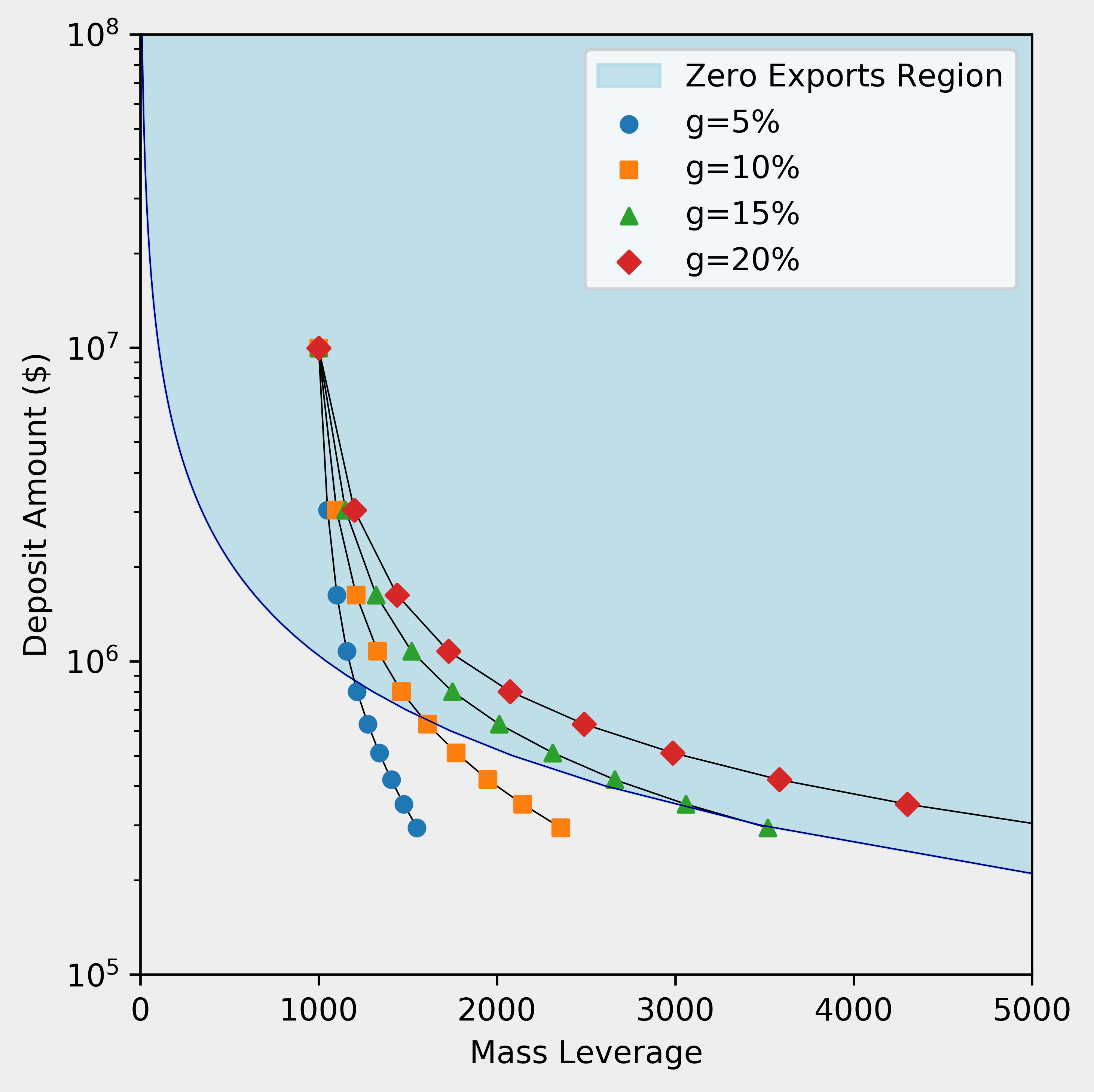
It did, however, require >15% year on year growth in the leverage rate to sustain if you want to stay in the zero exports region - i.e. where you can run the entire colony purely on this model. In reality, most colonies will be able to export something to make this close more easily.
Inflation
Some people noted in the original model I did not account for inflation in the returns. This is a fair point for most products, but recall that the overwhelming expense here (to the point we can basically ignore everything else) is launch costs, and launch costs are not inflating. The cost of launch is dropping and will likely continue to drop over time as new competitors enter the market and volume increases.
On longer timescales, where we want this model to still work, launch costs beyond Earth orbit will decrease through in space infrastructure, such as momentum exchange tethers, in space propellant production, and advances in propulsion. These technical improvements are beyond the scope of this article (although I cover them elsewhere), but suffice to say ignoring inflation is actually a conservative assumption here.
Children
I initially constructed this model to demonstrate a financially viable way of bootstrapping the colony - but the first question a lot of people raised was how the model looks when the colonists start having children.
In a situation where the birth rate matches the death rate, the situation is unchanged over the long period. However, a burgeoning space colony will likely aim to have a high fertility rate (especially if managed by Elon Musk!). So we need to account for the output of the colony fund being diluted by an increasing population.
It turns out that, because even at high TFR the annual growth rate is around 1-2%, this does not shift the model too much. A growth trajectory that is in the no exports region, 20% mass leverage growth per year, still remains there:
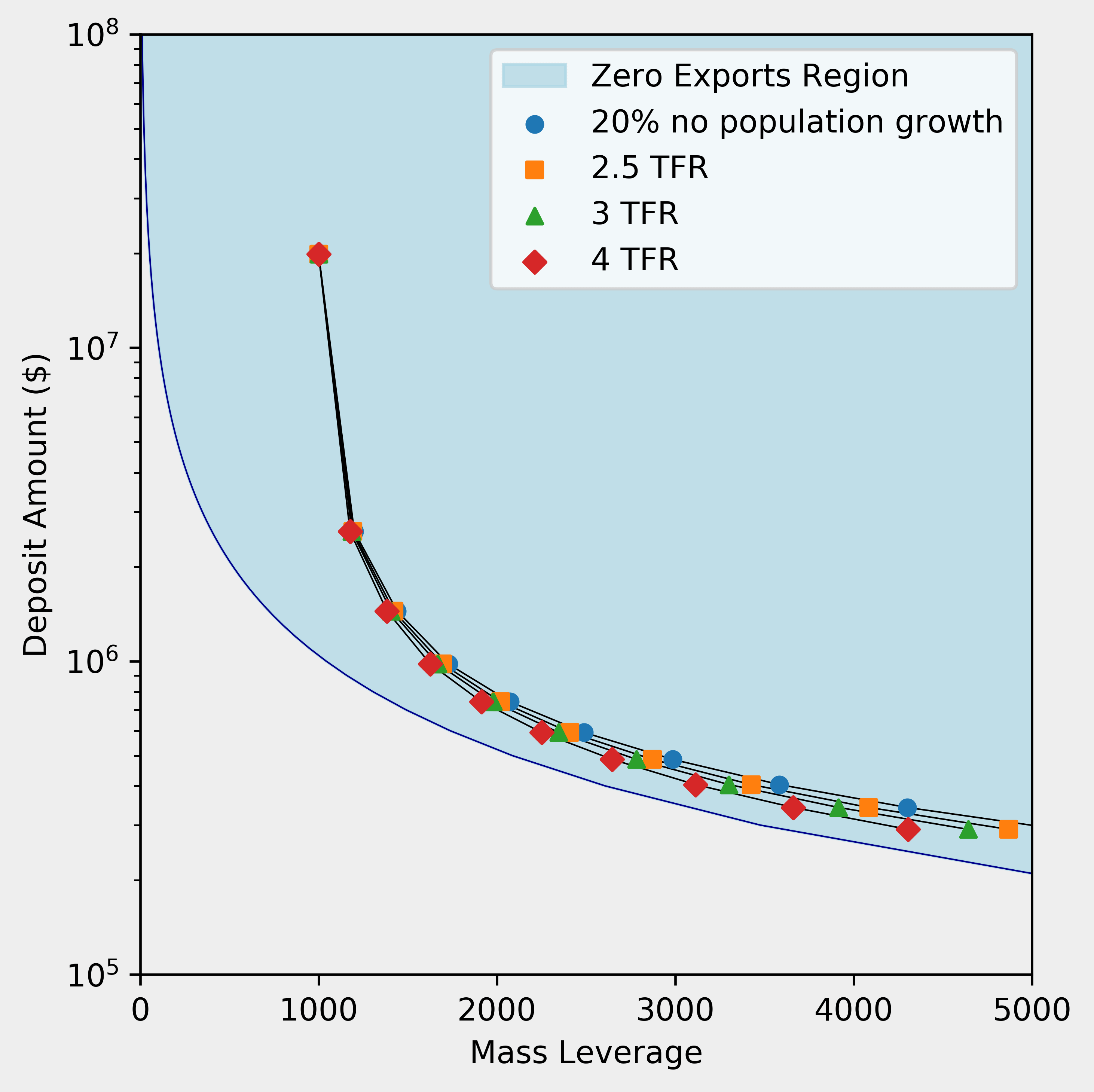
If a growth rate is only marginally self-sustaining, then it may make a difference. But the rate at which mass leverage can scale remains the overwhelmingly most important variable for the colonists.
Children require labour to look after them, reducing the workforce available for the main task of increasing the mass leverage. On the other hand, they can start helping out at a younger age than would be normal on Earth. Is changing the cartridge on a CO2 scrubber too hard for a 6 year old?
These dynamics are difficult to fit into this broad model, but in the end it doesn’t matter too much. Generally, people are sensitive to economic conditions when deciding whether or not to have children, and thus will only start having kids once they colony is well established and can support them. It will likely be some time after the initiation of the colony where this happens.
Those Left Behind
Previously I said that the colony fund would have to find some friendly jurisdiction to avoid being overly taxed and seized. This is one approach, but it may also be advantageous to accept some level of tax on the gains of the fund in order to secure the long term support of a state back on Earth.
A colonist travelling to space in this manner would, unusually for an emigrant, leave all of their current assets behind in the country they exit. If the returns on the fund are taxed, it essentially just shifts the curve downwards.
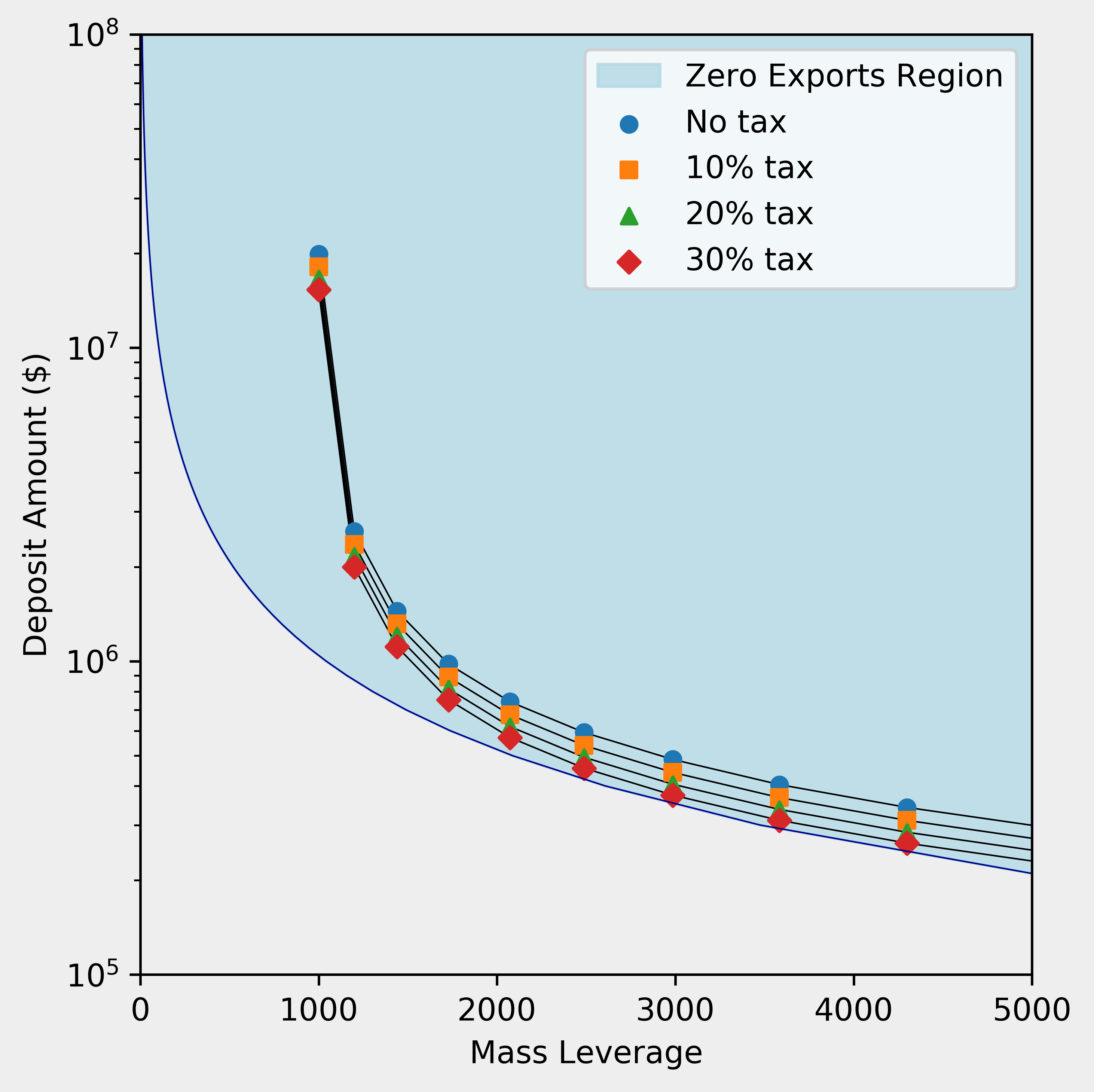
The impact is noticeable, but manageable, for reasonable levels of tax. Obviously if the tax became excessive, it could sink the enterprise. Some politicians may wish to do this on purpose. Others would do it simply out of the sense that there was a pot of money to grab at for their own short term needs.
My own government in the UK has unfortunately gone in this direction; recently some leaked WhatsApp messages from a cabinet minister shed light on the attitude, recounting his experience speaking to other Labour MPs:
Every meeting I have is: ‘Who can we tax in order to pay benefits to others?’
-Pat McFadden, Work and Pensions Secretary
A large fund of people who aren’t on the same planet to complain would be a juicy target for those looking to fund ever expansive claims on the treasury. Indeed, there are rumours that the incoming Prime Minister, Andy Burnham, is being advised to increase capital gains tax to the same level as income tax.
Punitive taxation on a fund of this sort would be shortsighted though. A country that hosted one at reasonable rates would find its domestic space launch well funded, as well as any industries supplying things the colony could not yet manufacture. The alternative would be for those interested in such an enterprise to flee the country, launch from a less extractive tax regime, and leave the treasury with nothing.
The colony and its launching country should not have an adversarial relationship. This is not a formula for abandoning society, but for extending it to the stars in a sustainable manner.
I’ll be continuing to refine it over time; any feedback is welcome and will inform future articles. I am therefore leaving comments open, and encouraging people to share the post.
It seems to me that a more plausible solution is that colonists just need to be doing economically valuable work ASAP. Which is hard, but ultimately necessary. If anything, the argument should be that colonists should pool their assets to buy economically productions and fund other startup costs.
The obvious one is space data centres. Obviously the main goal at this stage is orbital data centres. But honestly, Mars probably has a better profile aside from the obviously much higher launch costs. The thermal profile is a lot better. In theory you could even use waste heat to melt ice and maintain comfortable temp inside habitation modules.
Beyond that, a natural one would be maintaining space ports and way stations. For instance a moon base that regularly receives bulk food and fuel might make it more economical to faciltate launches into deeper space. But obviously the economics of this would be tricky.
Even more speculatively. It is possible that there are forms of advanced manufacturing that are only feasible in low/micro-gravity. Or that are simply more feasible in cold, ultra-quiet, low gravity environments like Mars and Luna. The problem here of course, is that it is probably not possible to conclusively test the viability of this without actually building out alot of the infra in the target environment.
Also asteroid mining obviously.
But what we really need is a ludicrously rich person who isn't afraid to blow a few hundred billion on a lot false starts and near misses to figure out how to establish a viable foothold in space...
"On the other hand, they can start helping out at a younger age than would be normal on Earth. Is changing the cartridge on a CO2 scrubber too hard for a 6 year old? "
You are obviously living in a rich, over-developed country. ;-) To be fair, essentially all colonists would come from the same population.
In much of the real world children start becoming economically active significantly before the age of six, whether it is tending toddlers, peeling vegetables or stopping goats from eating crops.
Statistics are easy to find (https://data.unicef.org/topic/child-protection/child-labour/ for example) where one category is for "Age 5 to 11 years: At least 1 hour of economic work or 21 hours of unpaid household services per week".
Paul