


We are living at a fulcrum of history. Yesterday, Artemis II rolled out from the Vehicle Assembly Building to the launch pad, targeting a launch on the 6th February. For the first time since 1972, humans will orbit another celestial body. In less than a month from the time of writing, the age of human interplanetary travel will restart, after being stalled for more than half a century.
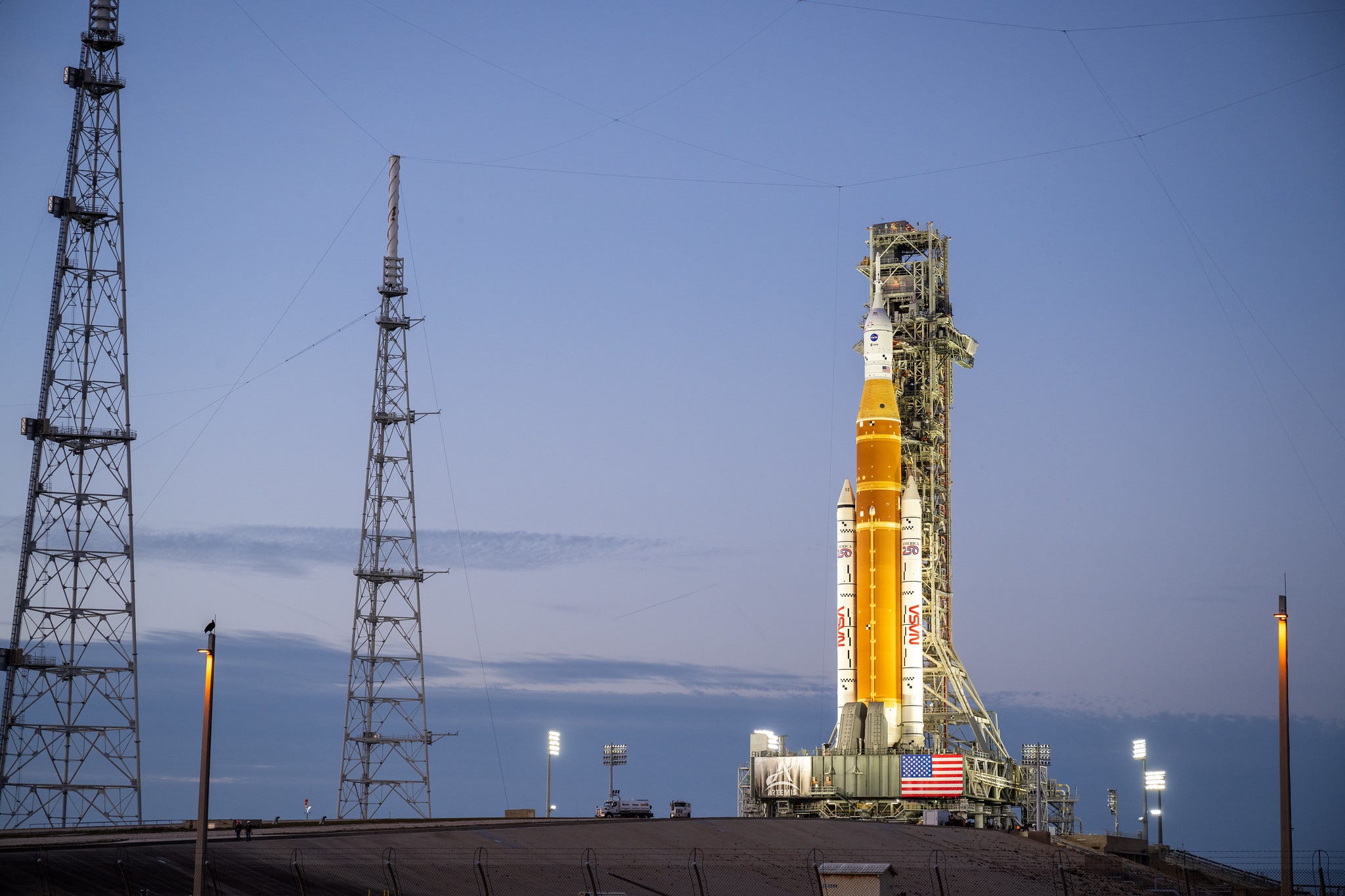
The program has been delayed substantially, and there are many criticisms of its execution. But the mission is a significant milestone nonetheless. It will not, in itself, lead to a sustained presence on the Moon - SLS can only send Orion into a loosely bound Lunar orbit, and has proven far too expensive for continued use. There are also serious technical criticisms of the rocket and spacecraft, which I will get into later. Likely it will be cancelled by 2030 after only a handful of missions. But, if all goes well, by that point more economical systems will have taken over.
The long term utility is most likely going to be in shifting public perceptions. The first step in securing investment in something is to convince backers that it is even possible. Even a once a year “flags and footprints” mission does this.
Speaking of footprints, though, SLS/Orion doesn’t come with a lander. From Artemis III onwards that part will be added by SpaceX and Blue Origin. The high orbit Orion flies in will mean both landers need very large propellant reserves to get to the lunar surface and back, which will mean many refuelling flights in both cases. It’s an architecture driven by incrementally building off previous political and engineering decisions, and not optimal - but it’s the one that is available now. A complete rework would likely add years of delay and probably mean the US ceding the South Pole of the Moon to China.
The Journey
When we look at the Moon in the sky, most of the time we do not get a good impression of how distant it is. This isn’t helped by many of the visualisations of the the Earth-Moon system, which tend not to be to scale.
I’ve decided to present a more physically accurate view of the journey of Artemis II for this post, and for the ones I will make during the mission to follow its progress. This is close to the orbit that will be flown, based on published parameters:
